Wednesday, December 25, 2024


James Donaldson on Mental Health - Americans over 75 have the highest rates of suicide. How to prevent depression with aging, according to AARP
BY Debra Whitman

Debra Whitman is executive vice president and chief public policy officer of AARP and the author of “The Second Fifty: Answers to the 7 Big Questions of Midlife and Beyond.”

The cold weather makes it harder for older people to get out, which can increase feelings of isolation and loneliness.

By midlife, Susan had seen a few therapists. A qualified lawyer and adjunct professor, she had struggled off and on with anxiety and depression and had developed a binge eating disorder. She was never hospitalized, but for years felt distressed by her symptoms.

Then, at age 60, she began psychotherapy she describes as “life-changing.” What made it so powerful, she told me, was that the therapist helped her let go of shame. “I’d be beating up on myself and she’d focus on noticing instead of judging. Her willingness to accept where I was and who I was helped me to stop judging and to accept myself.”

Shame and stigma have long accompanied mental health issues. Now, people are beginning to speak openly about their experiences, and policymakers are raising the alarm. This is especially important as we head into winter. The cold weather makes it harder for older people to get out, which can increase feelings of isolation and loneliness.

The Surgeon General, Vivek Murthy, has called attention to the mental health challenges facing children and young adults, and recently released a major report on the mental health of parents and caregivers of children. These are incredibly important steps, but we need to address mental health across the whole life course—including with older people, who are at some of the highest risks of social isolation and death by suicide and represent the fastest growing rate of mental health diagnoses.

The good news is that we know the sort of things that can help those who are suffering, but we must act decisively to ensure people of all ages get the care they need.  One in four Medicare beneficiaries live with mental illnesses such as depression, anxiety, schizophrenia, and bipolar disorder, with depression the most common diagnosis. About 12 million older people on Medicare report symptoms of depres­sion.

On the whole, emotional well-being does get better in our later decades. Recent AARP research showed that more than four in five people 60 and over feel happy and are optimistic about their future. But when older people have serious difficulties or feel isolated, the outcomes can be devastating: A new AARP survey finds that one in three women over age 60 report feeling sometimes or often lonely and about a quarter of women in this age group say they sometimes or often feel isolated.

More alarmingly, Americans 75 and over have the highest rate of suicide of any age group. In fact, the rate for men in this group is almost twice as high than it is for males age 15 to 24. Between 2001 and 2022, suicide rates actually increased significantly for men and women over 55, while it declined for those age 15 to 34. 

Making sense of the statistics

To better understand these trends, I called Kim Van Orden, a clinical geropsychologist at the University of Rochester who oversees the HOPE Lab—Helping Older People Engage. The lab studies the causes and effects of social isolation for older people and develops interventions to increase connectedness and prevent suicide. Van Orden explained two critical factors that together increase older people’s risk of death by suicide: feeling a lack of belonging—to relationships, social groups, or society—and feeling like a burden on others. She also cites the “5 Ds” linked to late-life suicide: depression, disconnection, disability, disease, and access to deadly means. 

Meanwhile, a shocking number of older people are going undiagnosed and untreated. Medicare covers depression screening as part of the Annual Wellness Visit, but only 6 percent of people with traditional Medicare were screened in 2018. One third of those with a mental illness don’t receive treatment. Medicare has improved access to mental health services, such as covering more types of counselors and therapists, but access still lags behind. I worked in the Senate on legislation passed in 2008 requiring private insurance to cover mental health conditions just as it does physical conditions. 

Unfortunately, that law didn’t include Medicare, which still limits the number of days of inpatient mental health treatment a person can get over their lifetime.  And Out-of-pocket costs can discourage people from seeking treatment.

Another reason for undertreatment may be the mistaken ageist assumption that older people should feel depressed. “But depression is not an inevitable part of aging,” Van Orden says. “Neither is loneliness or anxiety.” We can suffer in terms of our physical and cognitive health as we age, but we also tend to learn ways to adapt to those stressors.

And, when we struggle, there are treatments that work, including some used with younger people. A 2024 study by researchers from Macquarie University in Sydney, Australia examined the long-term effects of cognitive behavioral therapy (CBT) for older adults suffering from anxiety and/or depression. Ten years after either receiving CBT or participating in a facilitated support group, the CBT group had significantly lower rates of anxiety and depressive disorders.

#James Donaldson notes:Welcome to the “next chapter” of my life… being a voice and an advocate for #mentalhealthawarenessandsuicideprevention, especially pertaining to our younger generation of students and student-athletes.Getting men to speak up and reach out for help and assistance is one of my passions. Us men need to not suffer in silence or drown our sorrows in alcohol, hang out at bars and strip joints, or get involved with drug use.Having gone through a recent bout of #depression and #suicidalthoughts myself, I realize now, that I can make a huge difference in the lives of so many by sharing my story, and by sharing various resources I come across as I work in this space.  #http://bit.ly/JamesMentalHealthArticleFind out more about the work I do on my 501c3 non-profit foundationwebsite www.yourgiftoflife.org Order your copy of James Donaldson's latest book,#CelebratingYourGiftofLife: From The Verge of Suicide to a Life of Purpose and Joy

www.celebratingyourgiftoflife.com

Link for 40 Habits Signupbit.ly/40HabitsofMentalHealth

If you'd like to follow and receive my daily blog in to your inbox, just click on it with Follow It. Here's the link https://follow.it/james-donaldson-s-standing-above-the-crowd-s-blog-a-view-from-above-on-things-that-make-the-world-go-round?action=followPub

How to prevent mental health issues as we age

We can all take steps to support our mental health as we age and that of the older people in our lives. Perhaps most important is connecting with our primary care doctor—or, better still, a geriatrician—and talking about any mental health concerns.

Be proactive about staying connected so as not to slip into isolation. One program Van Orden’s team uses helps people to identify their drivers of loneliness and create social action plans. It could start by simply inviting someone for a walk or coffee. Even “peripheral” social ties—acquaintances, people met at group events, your bank teller—have been linked to more physical activity, better mood, and fewer negative feelings.

Meanwhile, family, friends, and medical professionals should know the signs of depression and anxiety. Older people may be uncomfortable discussing mental health or will use different language—more likely, for instance, to mention difficulty sleeping or lack of concentration than a sad mood. Younger people in their lives can help by talking openly of their own challenges and treatments. And, especially with the onset of winter, we can all remember to check in on those who may be isolated.

Help is out there. And, as Susan reminded me, life-changing treatment can begin at any age. “It’s never too late,” she said. “Every day counts. And getting help matters. You matter. Your life matters.” https://standingabovethecrowd.com/?p=13408

Tuesday, December 24, 2024


James Donaldson on Mental Health - How to help kids process self-harm and suicide content in media
Learn how to help kids process self-harm and suicide content in media with effective strategies and communication tips

By Joanne Cabrera, Licensed Mental Health Therapist at CHOC

What is the importance of helping kids process self-harm and suicide content in media?

Our youth are constantly exposed to inappropriate, serious or harmful content through various media outlets, such as television, radio and social media. What can we do, as caregivers, to help our youth process their thoughts and feelings about media content in a healthy way?

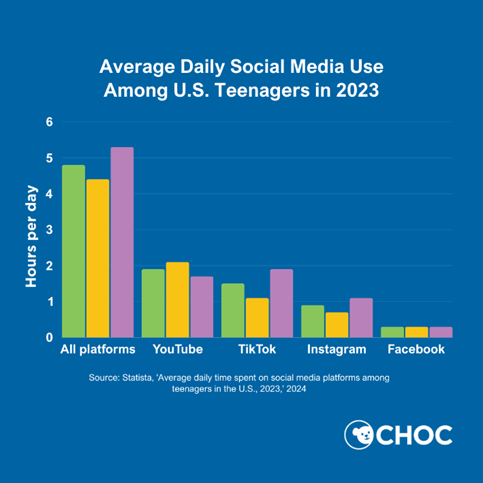
A 2023 survey conducted in the United States, found that teenagers spent an average of 4.8 hours on social media platforms every day. Girls spent nearly an hour more on social networks than boys, averaging 5.3 hours compared to 4.4 hours. Teens aged 13 to 19 preferred YouTube and TikTok, engaging with them for an average of 1.9 and 1.5 hours daily, respectively.

Average daily social media use among U.S teenagers in 2023

In general, boys spent more time on YouTube, while girls spent more time on TikTok (Statista Research Department 2024). These statistics show that youth spend a significant amount of time on media sites, which can often be biased, subjective and misleading.

While media can offer valuable resources, raise awareness about mental health, and provide current news, it can also negatively impact young people’s mental health and well-being. Open discussions about the content young people watch and read are important.

Read: Social Media Tips for Kids and Teens

How can caregivers help kids process self-harm and suicide content in media?
Caregivers, educators and mental health professionals must work together to reduce the stigma around mental health, self-harm and suicide.

According to the National Institute of Mental Health (NIMH), approximately 17 percent of adolescents aged 12 to 17 have engaged in self-harm at some point. The COVID-19 lockdown increased young people’s reliance on media, highlighting the need for greater awareness.

Since children’s brains do not fully develop until around age 25, we must listen to them nonjudgmentally, simplify difficult topics and address their questions and concerns. While we may not agree with everything our children say, it’s vital to validate their feelings and experiences.

How can self-harm and suicide content in media influence kids’ behaviors and attitudes?

Media includes various platforms and formats that provide information, entertainment and communication. Media categories include print media, broadcast media, digital media, streaming media, interactive media and advertising.

These media forms can influence perception, behavior and mental health, particularly among children and young audiences. Children constantly encounter information and often take what they see and hear at face value. They must have opportunities to process their feelings, ask questions and understand the content they encounter.

For example, the show 13 Reasons Why depicted a young girl discussing self-harm and suicide due to bullying, sparking controversy over the potential glamorization of these topics. According to the National Institute of Mental Health (2019), suicide attempts reportedly increased by 28 percent following the show’s premiere.

While some adults attempted to ban the show, the information remained easily accessible, fueling curiosity among youth.

Children also encounter self-harm content on social media platforms like Instagram, TikTok, and Discord, which can create a copycat effect. When children learn about suicide and self-harm through media, it presents an opportunity for caregivers and educators to discuss these issues with them.

As kids navigate their identities and seek connection through trending themes on platforms like Facebook, Instagram and Snapchat, they often feel comfortable sharing their deepest thoughts and fears with strangers, learning from the experiences of others.

Read: Making your home safe for a suicidal or self-harming child

What are the mental health effects of self-harm and suicide content in media on kids?

Media coverage of self-harm and suicide can deeply impact children’s mental and physical health. For instance, hearing about natural disasters or tragedies during car rides can weigh heavily on their minds, affecting their mood throughout the day.

How can open conversations help kids process self-harm and suicide content in media?

Caregivers must be mindful of the media content playing in cars and at home, especially during meals or study time. While we can’t shield children from all harmful information, we can engage them in conversations about its effects and help them process their understanding of what they hear.

Exposure to distressing media can lead to feelings of loneliness, anxiety, depression, anger, fear and emotional exhaustion for youth. There is a misconception that discussing topics like mental health, self-harm and suicide may plant harmful thoughts in children’s minds.

Open dialogue, however, can help kids process self-harm and suicide content in media in a way that minimizes negative effects.
The Centers for Disease Control and Prevention (CDC) reported that suicide was the second leading cause of death among individuals aged 10 to 24 in 2021, highlighting the urgency of this concern. Additionally, children may experience sleep disturbances, nightmares and feelings of unsafety after encountering distressing media.

They might also normalize or glamorize harmful behaviors if they see role models engaging in them. Exposure to difficult news can create anxiety and confusion, making it challenging for children to know how to seek help. If they internalize their feelings, they risk becoming desensitized to serious topics and behaviors due to constant exposure.

#James Donaldson notes:Welcome to the “next chapter” of my life… being a voice and an advocate for #mentalhealthawarenessandsuicideprevention, especially pertaining to our younger generation of students and student-athletes.Getting men to speak up and reach out for help and assistance is one of my passions. Us men need to not suffer in silence or drown our sorrows in alcohol, hang out at bars and strip joints, or get involved with drug use.Having gone through a recent bout of #depression and #suicidalthoughts myself, I realize now, that I can make a huge difference in the lives of so many by sharing my story, and by sharing various resources I come across as I work in this space.  #http://bit.ly/JamesMentalHealthArticleFind out more about the work I do on my 501c3 non-profit foundationwebsite www.yourgiftoflife.org Order your copy of James Donaldson's latest book,#CelebratingYourGiftofLife: From The Verge of Suicide to a Life of Purpose and Joy

www.CelebratingYourGiftofLife.com

Link for 40 Habits Signupbit.ly/40HabitsofMentalHealth

If you'd like to follow and receive my daily blog in to your inbox, just click on it with Follow It. Here's the link https://follow.it/james-donaldson-s-standing-above-the-crowd-s-blog-a-view-from-above-on-things-that-make-the-world-go-round?action=followPub

Proactive measures to help kids process self-harm and suicide content in media

As children continually encounter sensitive topics through various media platforms, proactive measures can make a difference in how we help kids process self-harm and suicide content in the media.

Communication and education are essential for helping youth understand the potential impact of harmful information. Daily check-ins can foster healthy habits, providing a safe space for children to voice their questions, feelings and concerns about their schools, friendships, or news events.

What strategies can caregivers use to help kids process self-harm and suicide content in media?

It’s important to listen actively, allowing children to share their experiences before offering advice. Validate their feelings and gently correct any misinformation they may have encountered, all while maintaining a calm and nonjudgmental tone.

Remember to create an environment that encourages questions, where it’s okay not to have all the answers. Exploring those answers together can be empowering.

Finally, don’t forget to praise and positively reinforce your child for coming to you with their thoughts and for being open to discussing important topics. This support can strengthen your relationship and help them navigate their understanding of complex issues.

Strategies to help kids process self-harm and suicide content in media

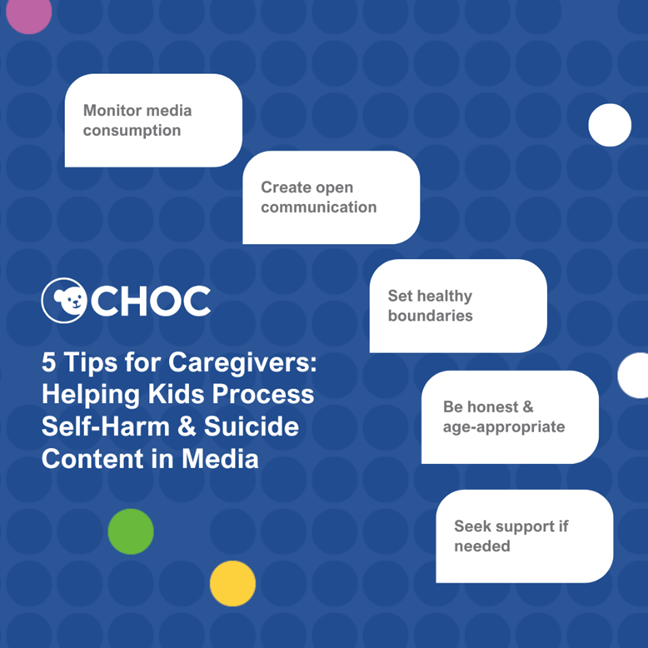
Seven actionable steps caregivers can take to help kids process self-harm and suicide content in media
- Be mindful: Monitor what your child is listening to and watching

- Monitor internet use: internet sites they are spending their time on.

- Find time to check-in with your child: Take an interest in what they are doing and create a safe space for them to share things with you.  

- Teach healthy boundaries: Go over boundaries regarding electronic device use and share guidelines about media to encourage positive coping skills.

- Be honest: Be transparent with children when explaining things and try to answer their questions objectively in an age-appropriate manner.

- Leverage technology: Look into helpful parent control apps where you can monitor safety-related issues that may arise.

- Seek support if needed: If you notice changes in your child’s mood or behavior, such as disruptions in sleep, appetite or school/social engagement, seek mental health resources for support.

List of Caregiver Monitoring and Safety Applications

- MamaBear App: Monitors your child’s location and online activity, helping ensure their safety both in the real world and on the internet.

- Bark: Monitors texts, emails, YouTube and social media for signs of bullying, inappropriate content, threats or abuse, helping to keep children safe online

- mSpy: Monitors electronic use to help protect children from safety-related risks by tracking activities across texts, calls, social media and more.

- Checky: Monitors how many times you check your phone throughout the day to be self-aware of use.  

- Screen Time App: Tracks and monitors screen time use, helping users develop bettertime managementhabits.

- OurPact Child App: Helps families manage screen time and set boundaries for electronic use by creating personalized contracts between family members to promote accountability.

Get more expert health advice delivered to your inbox monthly by subscribing to the KidsHealth newsletter here.

Learn more about CHOC’s pediatric mental health services

At CHOC, we specialize in providing a full spectrum of pediatric mental healthcare, including inpatient, intensive outpatient and outpatient program services.

Get resources

Get 24/7 advice from CHOC

Call our free nurse helpline at 1-844-GET-CHOC

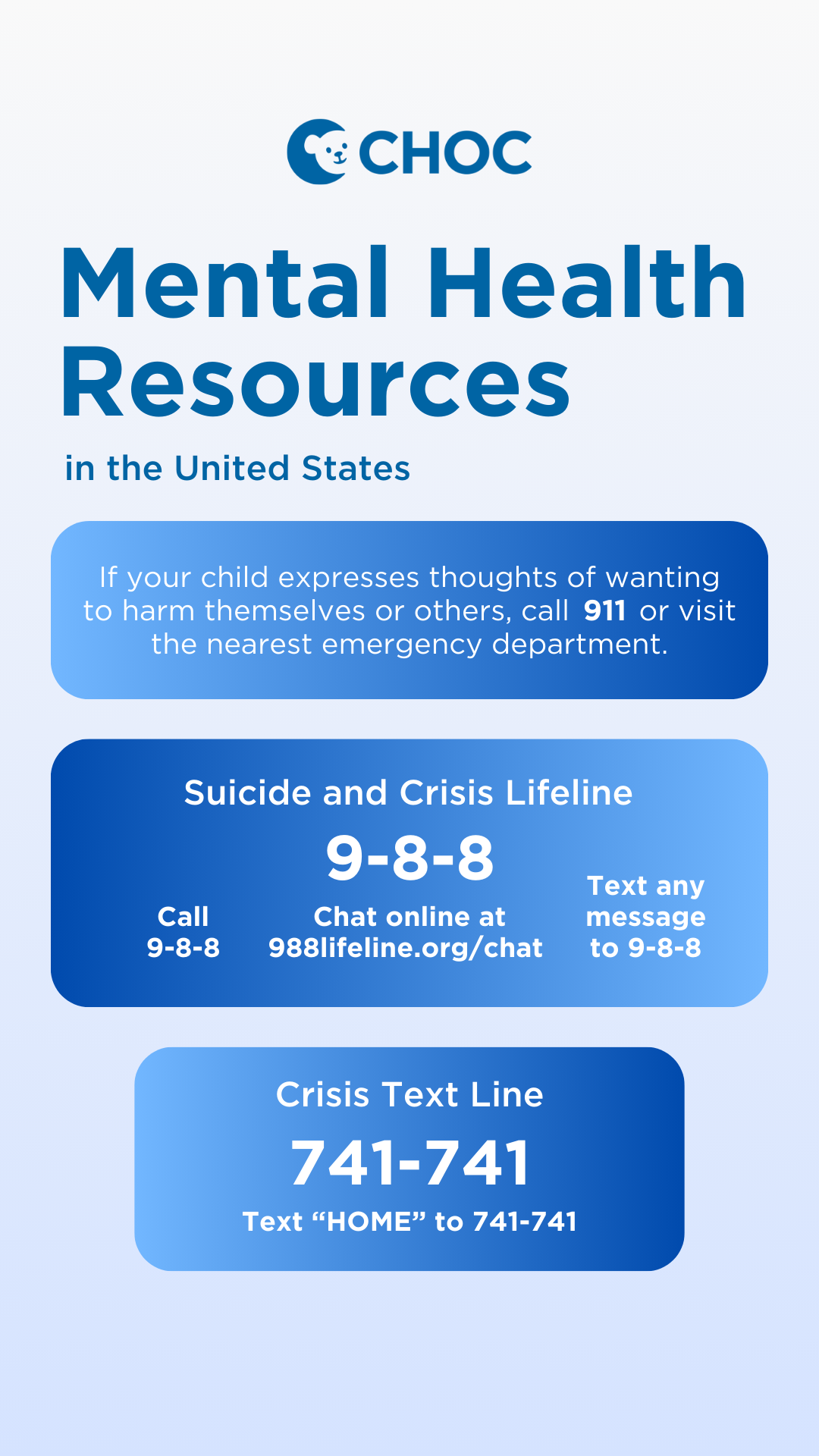
Crisis Resources

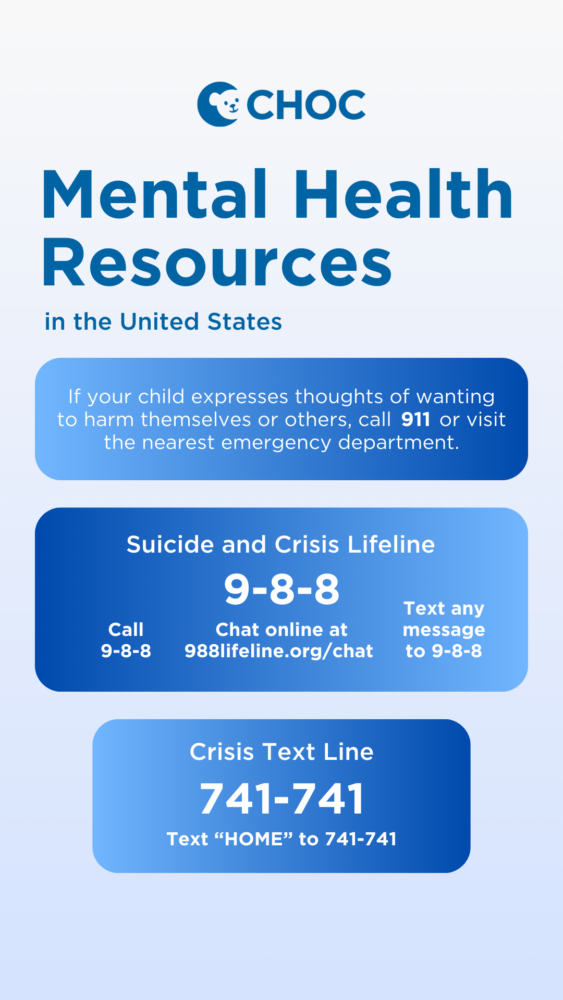
If your child expresses thoughts of wanting to harm themselves or others, call 9-1-1 or visit the nearest emergency department.

988 Suicide and Crisis Lifeline:

Call 9-8-8

Text any message to 9-8-8

Chat online at 988lifeline.org/chat

Crisis Text Line:

Text “HOME” to 741741

Save for later

Download, print or share on social media.

Download

Additional Resources

- Trevor Lifeline (LGBTQ+ Suicide Hotline): (866) 488-7386

- OC-LINKS (Mental Health Resources): (855) 625-4657

- NAMI Warm Line (Emotional/Mental Health Support): (714) 991-6412 https://standingabovethecrowd.com/james-donaldson-on-mental-health-how-to-help-kids-process-self-harm-and-suicide-content-in-media/

James Donaldson on Mental Health - How to help kids process self-harm and suicide content in media

James Donaldson on Mental Health - How to help kids process self-harm and suicide content in media

Learn how to help kids process self-harm and suicide content in media with effective strategies and communication tips


By Joanne Cabrera, Licensed Mental Health Therapist at CHOC


What is the importance of helping kids process self-harm and suicide content in media?

Our youth are constantly exposed to inappropriate, serious or harmful content through various media outlets, such as television, radio and social media. What can we do, as caregivers, to help our youth process their thoughts and feelings about media content in a healthy way?


A 2023 survey conducted in the United States, found that teenagers spent an average of 4.8 hours on social media platforms every day. Girls spent nearly an hour more on social networks than boys, averaging 5.3 hours compared to 4.4 hours. Teens aged 13 to 19 preferred YouTube and TikTok, engaging with them for an average of 1.9 and 1.5 hours daily, respectively.


Average daily social media use among U.S teenagers in 2023. Learn how to help kids process self-harm and suicide content in media with effective communication tips.Average daily social media use among U.S teenagers in 2023

In general, boys spent more time on YouTube, while girls spent more time on TikTok (Statista Research Department 2024). These statistics show that youth spend a significant amount of time on media sites, which can often be biased, subjective and misleading.


While media can offer valuable resources, raise awareness about mental health, and provide current news, it can also negatively impact young people’s mental health and well-being. Open discussions about the content young people watch and read are important.


Read: Social Media Tips for Kids and Teens


How can caregivers help kids process self-harm and suicide content in media?

Caregivers, educators and mental health professionals must work together to reduce the stigma around mental health, self-harm and suicide.


According to the National Institute of Mental Health (NIMH), approximately 17 percent of adolescents aged 12 to 17 have engaged in self-harm at some point. The COVID-19 lockdown increased young people’s reliance on media, highlighting the need for greater awareness.


Since children’s brains do not fully develop until around age 25, we must listen to them nonjudgmentally, simplify difficult topics and address their questions and concerns. While we may not agree with everything our children say, it’s vital to validate their feelings and experiences.


How can self-harm and suicide content in media influence kids’ behaviors and attitudes?

Media includes various platforms and formats that provide information, entertainment and communication. Media categories include print media, broadcast media, digital media, streaming media, interactive media and advertising.


These media forms can influence perception, behavior and mental health, particularly among children and young audiences. Children constantly encounter information and often take what they see and hear at face value. They must have opportunities to process their feelings, ask questions and understand the content they encounter.


For example, the show 13 Reasons Why depicted a young girl discussing self-harm and suicide due to bullying, sparking controversy over the potential glamorization of these topics. According to the National Institute of Mental Health (2019), suicide attempts reportedly increased by 28 percent following the show’s premiere.


While some adults attempted to ban the show, the information remained easily accessible, fueling curiosity among youth.


Children also encounter self-harm content on social media platforms like Instagram, TikTok, and Discord, which can create a copycat effect. When children learn about suicide and self-harm through media, it presents an opportunity for caregivers and educators to discuss these issues with them.


As kids navigate their identities and seek connection through trending themes on platforms like Facebook, Instagram and Snapchat, they often feel comfortable sharing their deepest thoughts and fears with strangers, learning from the experiences of others.


Read: Making your home safe for a suicidal or self-harming child


What are the mental health effects of self-harm and suicide content in media on kids?

Media coverage of self-harm and suicide can deeply impact children’s mental and physical health. For instance, hearing about natural disasters or tragedies during car rides can weigh heavily on their minds, affecting their mood throughout the day.


How can open conversations help kids process self-harm and suicide content in media?

Caregivers must be mindful of the media content playing in cars and at home, especially during meals or study time. While we can’t shield children from all harmful information, we can engage them in conversations about its effects and help them process their understanding of what they hear.


Exposure to distressing media can lead to feelings of loneliness, anxiety, depression, anger, fear and emotional exhaustion for youth. There is a misconception that discussing topics like mental health, self-harm and suicide may plant harmful thoughts in children’s minds.


Open dialogue, however, can help kids process self-harm and suicide content in media in a way that minimizes negative effects.


The Centers for Disease Control and Prevention (CDC) reported that suicide was the second leading cause of death among individuals aged 10 to 24 in 2021, highlighting the urgency of this concern. Additionally, children may experience sleep disturbances, nightmares and feelings of unsafety after encountering distressing media.


They might also normalize or glamorize harmful behaviors if they see role models engaging in them. Exposure to difficult news can create anxiety and confusion, making it challenging for children to know how to seek help. If they internalize their feelings, they risk becoming desensitized to serious topics and behaviors due to constant exposure.


#James Donaldson notes:
Welcome to the “next chapter” of my life… being a voice and an advocate for #mentalhealthawarenessandsuicideprevention, especially pertaining to our younger generation of students and student-athletes.
Getting men to speak up and reach out for help and assistance is one of my passions. Us men need to not suffer in silence or drown our sorrows in alcohol, hang out at bars and strip joints, or get involved with drug use.
Having gone through a recent bout of #depression and #suicidalthoughts myself, I realize now, that I can make a huge difference in the lives of so many by sharing my story, and by sharing various resources I come across as I work in this space.
  #http://bit.ly/JamesMentalHealthArticle
Find out more about the work I do on my 501c3 non-profit foundation
website www.yourgiftoflife.org Order your copy of James Donaldson's latest book,
#CelebratingYourGiftofLife: From The Verge of Suicide to a Life of Purpose and Joy


www.CelebratingYourGiftofLife.com


Link for 40 Habits Signup
bit.ly/40HabitsofMentalHealth


If you'd like to follow and receive my daily blog in to your inbox, just click on it with Follow It. Here's the link https://follow.it/james-donaldson-s-standing-above-the-crowd-s-blog-a-view-from-above-on-things-that-make-the-world-go-round?action=followPub


Proactive measures to help kids process self-harm and suicide content in media

As children continually encounter sensitive topics through various media platforms, proactive measures can make a difference in how we help kids process self-harm and suicide content in the media.


Communication and education are essential for helping youth understand the potential impact of harmful information. Daily check-ins can foster healthy habits, providing a safe space for children to voice their questions, feelings and concerns about their schools, friendships, or news events.


What strategies can caregivers use to help kids process self-harm and suicide content in media?

It’s important to listen actively, allowing children to share their experiences before offering advice. Validate their feelings and gently correct any misinformation they may have encountered, all while maintaining a calm and nonjudgmental tone.


Remember to create an environment that encourages questions, where it’s okay not to have all the answers. Exploring those answers together can be empowering.


Finally, don’t forget to praise and positively reinforce your child for coming to you with their thoughts and for being open to discussing important topics. This support can strengthen your relationship and help them navigate their understanding of complex issues.


Strategies to help kids process self-harm and suicide content in media with effective strategies and communication tips.Strategies to help kids process self-harm and suicide content in media

Seven actionable steps caregivers can take to help kids process self-harm and suicide content in media


- Be mindful: Monitor what your child is listening to and watching
- Monitor internet use: internet sites they are spending their time on.
- Find time to check-in with your child: Take an interest in what they are doing and create a safe space for them to share things with you.  
- Teach healthy boundaries: Go over boundaries regarding electronic device use and share guidelines about media to encourage positive coping skills.
- Be honest: Be transparent with children when explaining things and try to answer their questions objectively in an age-appropriate manner.
- Leverage technology: Look into helpful parent control apps where you can monitor safety-related issues that may arise.
- Seek support if needed: If you notice changes in your child’s mood or behavior, such as disruptions in sleep, appetite or school/social engagement, seek mental health resources for support.
List of Caregiver Monitoring and Safety Applications
- MamaBear App: Monitors your child’s location and online activity, helping ensure their safety both in the real world and on the internet.
- Bark: Monitors texts, emails, YouTube and social media for signs of bullying, inappropriate content, threats or abuse, helping to keep children safe online
- mSpy: Monitors electronic use to help protect children from safety-related risks by tracking activities across texts, calls, social media and more.
- Checky: Monitors how many times you check your phone throughout the day to be self-aware of use.  
- Screen Time App: Tracks and monitors screen time use, helping users develop bettertime managementhabits.
- OurPact Child App: Helps families manage screen time and set boundaries for electronic use by creating personalized contracts between family members to promote accountability.

Get more expert health advice delivered to your inbox monthly by subscribing to the KidsHealth newsletter here.


Learn more about CHOC’s pediatric mental health services

At CHOC, we specialize in providing a full spectrum of pediatric mental healthcare, including inpatient, intensive outpatient and outpatient program services.


Get resources


Get 24/7 advice from CHOC

Call our free nurse helpline at 1-844-GET-CHOC


Crisis Resources


If your child expresses thoughts of wanting to harm themselves or others, call 9-1-1 or visit the nearest emergency department.


988 Suicide and Crisis Lifeline:

Call 9-8-8


Text any message to 9-8-8


Chat online at 988lifeline.org/chat


Crisis Text Line:

Text “HOME” to 741741


Save for later

Download, print or share on social media.


Download


Mental health crisis resources and phone numbers - United States

Additional Resources


- Trevor Lifeline (LGBTQ+ Suicide Hotline): (866) 488-7386
- OC-LINKS (Mental Health Resources): (855) 625-4657
- NAMI Warm Line (Emotional/Mental Health Support): (714) 991-6412
https://standingabovethecrowd.com/james-donaldson-on-mental-health-how-to-help-kids-process-self-harm-and-suicide-content-in-media/

Monday, December 23, 2024


James Donaldson on Mental Health - Unseen Asian teen suicide risks
Study raises concern about lumping all Asian ethnic groups under “Asian American” label

Photo by Mental Health America (MHA) on Pexels.com

By Cheryl Murfin

The risk of committing suicide is lower for the overarching group labeled “Asian youth” compared to non-Asian peers (9.17 deaths per 100,000 compared to 10.77 per 100,000). But researchers at Seattle Children’s Research Institute’s Center for Child Health, Behavior and Development say lumping all Asian kids into a single group leads to missing the trees for the forest. 

According to new institute research, Asian youth suicide rates differ among ethnic subgroups, including Chinese, Filipino, Indian, Korean, Vietnamese, Indian, Japanese, and others. The new study, published in JAMA Pediatrics and led by Seattle Children’s Anthony L. Bui, MD, MPH, found, for example, that Indian and Chinese youths showed the lowest rate of suicide while Korean and Vietnamese teens showed higher rates. 

Increased stressors

Averaging data across all subgroups, says Bui, reduces the urgency around providing mental health research and services aimed at understanding and supporting Asian American youth. 

“The increase in Asian American youth suicide rates coincides with events we’ve seen in our communities and read on the news over the past few years. We know this is playing out locally here in Seattle,” Bui says. “The experience of being Asian has been more stressful. There are more incidents of anti-Asian and xenophobia, including violence, threats and verbal abuse, bullying, and hate incidents. ”

Many cultures, not one group

Asian ethnic groups are some of the fastest-growing and diverse populations in the nation and state. Each one, Bui points out, has its own language, culture, and other social characteristics. 

In Washington, Asian communities make up between 10% and 13% of the state’s population. According to the Washington State Commission Asian Pacific American Affairs, there are 48 district sub-ethnic cultures under the Asian American or Pacific Islander overall groupings. 

Most of those residents live in Puget Sound, with King County having the highest population.

Anti-Asian sentiments contribute to youth mental health challenges

A study by The Asian American Foundation found that 40% of Asian people in Seattle experienced anti-Asian hate in the past year. 

“The stress from racism and anti-immigrant sentiment is likely a large cause of why there are higher rates of mental illness and suicide among Asian American youth,” Bui says.

This new research pushes against the singular “model minority” stereotype of Asians, especially for kids. 

“That is a dangerous and harmful stereotype that continues to persist in our communities and likely has contributed to increased rates of mental illness and suicide among Asian American youth,” Bui says. “This stereotype generalizes Asians to be academically gifted, hardworking, and well-adjusted. The stereotype creates unfair and unrealistic societal pressures on Asian youth to achieve constantly, and it also results in poorer recognition of mental health conditions among Asian youth.” 

Further, it places pressure on Asian youth to avoid seeking help for mental health struggles.

“It’s no surprise that Asian youth have the lowest rates of mental healthcare use compared to other racial groups,” Bui says. “Studies have shown that stigma against mental health contributes to this. As a result, many Asian youth do not get the care they need to treat their mental health conditions.” 

Washington youth suicide numbers

More broadly, an average of 2.6 young people between the ages of 10 and 24 end their lives each week in Washington State according to Harborview Injury Prevention & Research Center. An average of 17 adolescents are admitted to the hospital with non-fatal suicidal behavior. Seattle-Tacoma has the second highest suicide attempt rate out of the 33 largest metropolitan areas in the United States.

The new study from Seattle Children’s is a step toward teasing out the ethnicity-related nuances that impact youth rates.

“Few public health studies currently divide Asian Americans into more specific ethnic categories,” Bui says. “While we know that suicide is a leading cause of death for Asian American youth and young adults, this research is one of the first attempts to understand how these rates differ across Asian ethnicities.”

He adds, “This study adds to the evidence that Asians are not a monolith, but instead a composition of many diverse ethnicities, cultures, languages, and people with differing historical experiences that brought them or their families to the U.S.”

#James Donaldson notes:Welcome to the “next chapter” of my life… being a voice and an advocate for #mentalhealthawarenessandsuicideprevention, especially pertaining to our younger generation of students and student-athletes.Getting men to speak up and reach out for help and assistance is one of my passions. Us men need to not suffer in silence or drown our sorrows in alcohol, hang out at bars and strip joints, or get involved with drug use.Having gone through a recent bout of #depression and #suicidalthoughts myself, I realize now, that I can make a huge difference in the lives of so many by sharing my story, and by sharing various resources I come across as I work in this space.  #http://bit.ly/JamesMentalHealthArticleFind out more about the work I do on my 501c3 non-profit foundationwebsite www.yourgiftoflife.org Order your copy of James Donaldson's latest book,#CelebratingYourGiftofLife: From The Verge of Suicide to a Life of Purpose and Joy

www.celebratingyourgiftoflife.com

Link for 40 Habits Signupbit.ly/40HabitsofMentalHealth

If you'd like to follow and receive my daily blog in to your inbox, just click on it with Follow It. Here's the link https://follow.it/james-donaldson-s-standing-above-the-crowd-s-blog-a-view-from-above-on-things-that-make-the-world-go-round?action=followPub

A hope: Providing support where it’s needed

Bui is hopeful his more inclusive and specific approach to research will lead to positive change. 

“We know that Vietnamese youth have disproportionately higher rates of suicide compared to other Asian groups,” he explains. “Knowing this, one of our next questions is, of course – what can we do about this? We know that Vietnamese and other Southeast Asian groups have the lowest use of mental healthcare services. I am currently working on a study supported by Seattle Children’s, the Academic Pediatric Association, and the American Board of Pediatrics Foundation to interview Vietnamese American families and understand why that is.”

The end goal of the new research project? “We hope this information will help us build culturally tailored solutions to better connect Vietnamese youth to the care they need,” Bui says. Looking forward, he hopes to continue to work on projects that partner with communities to reduce youth mental health disparities, including among underserved youth of immigrant origin.

New Help for Seattle tweens and teens

A new mental health program is now providing free virtual therapy services for ages 13 to 24 in Seattle. Launched this week, the program is the result of a $14.55 million partnership between the Seattle Department of Education and Early Learning and Seattle Public Schools. It will allow teens and young adults to access Talkspace, an online behavioral health company, to connect and communicate with Washington-licensed mental health providers for free. It will also give them access to a self-guided mental health program aimed at helping users cope with life stresses, anxiety, depression and other challenges.

The program is now open and teens can go to www.talkspace.com/seattle to sign up for therapy.

Seeking families for research

Bui is recruiting Vietnamese teenagers ages 12 to 18 in Washington or their parents or guardians for his current research. If you are interested in participating in a study, email Bui’s lab at BuiLab@seattlechildrens.org.

Photo by Mental Health America (MHA) on Pexels.com https://standingabovethecrowd.com/james-donaldson-on-mental-health-unseen-asian-teen-suicide-risks/

James Donaldson on Mental Health - Unseen Asian teen suicide risks

James Donaldson on Mental Health - Unseen Asian teen suicide risks

Study raises concern about lumping all Asian ethnic groups under “Asian American” label


Photo by Mental Health America (MHA) on Pexels.com

By Cheryl Murfin


The risk of committing suicide is lower for the overarching group labeled “Asian youth” compared to non-Asian peers (9.17 deaths per 100,000 compared to 10.77 per 100,000). But researchers at Seattle Children’s Research Institute’s Center for Child Health, Behavior and Development say lumping all Asian kids into a single group leads to missing the trees for the forest. 


According to new institute research, Asian youth suicide rates differ among ethnic subgroups, including Chinese, Filipino, Indian, Korean, Vietnamese, Indian, Japanese, and others. The new study, published in JAMA Pediatrics and led by Seattle Children’s Anthony L. Bui, MD, MPH, found, for example, that Indian and Chinese youths showed the lowest rate of suicide while Korean and Vietnamese teens showed higher rates. 


Increased stressors

Averaging data across all subgroups, says Bui, reduces the urgency around providing mental health research and services aimed at understanding and supporting Asian American youth. 


“The increase in Asian American youth suicide rates coincides with events we’ve seen in our communities and read on the news over the past few years. We know this is playing out locally here in Seattle,” Bui says. “The experience of being Asian has been more stressful. There are more incidents of anti-Asian and xenophobia, including violence, threats and verbal abuse, bullying, and hate incidents. ”


Many cultures, not one group

Asian ethnic groups are some of the fastest-growing and diverse populations in the nation and state. Each one, Bui points out, has its own language, culture, and other social characteristics. 


In Washington, Asian communities make up between 10% and 13% of the state’s population. According to the Washington State Commission Asian Pacific American Affairs, there are 48 district sub-ethnic cultures under the Asian American or Pacific Islander overall groupings. 


Most of those residents live in Puget Sound, with King County having the highest population.


Anti-Asian sentiments contribute to youth mental health challenges

A study by The Asian American Foundation found that 40% of Asian people in Seattle experienced anti-Asian hate in the past year. 


“The stress from racism and anti-immigrant sentiment is likely a large cause of why there are higher rates of mental illness and suicide among Asian American youth,” Bui says.


This new research pushes against the singular “model minority” stereotype of Asians, especially for kids. 


“That is a dangerous and harmful stereotype that continues to persist in our communities and likely has contributed to increased rates of mental illness and suicide among Asian American youth,” Bui says. “This stereotype generalizes Asians to be academically gifted, hardworking, and well-adjusted. The stereotype creates unfair and unrealistic societal pressures on Asian youth to achieve constantly, and it also results in poorer recognition of mental health conditions among Asian youth.” 


Further, it places pressure on Asian youth to avoid seeking help for mental health struggles.


“It’s no surprise that Asian youth have the lowest rates of mental healthcare use compared to other racial groups,” Bui says. “Studies have shown that stigma against mental health contributes to this. As a result, many Asian youth do not get the care they need to treat their mental health conditions.” 


Washington youth suicide numbers

More broadly, an average of 2.6 young people between the ages of 10 and 24 end their lives each week in Washington State according to Harborview Injury Prevention & Research Center. An average of 17 adolescents are admitted to the hospital with non-fatal suicidal behavior. Seattle-Tacoma has the second highest suicide attempt rate out of the 33 largest metropolitan areas in the United States.


The new study from Seattle Children’s is a step toward teasing out the ethnicity-related nuances that impact youth rates.


“Few public health studies currently divide Asian Americans into more specific ethnic categories,” Bui says. “While we know that suicide is a leading cause of death for Asian American youth and young adults, this research is one of the first attempts to understand how these rates differ across Asian ethnicities.”


He adds, “This study adds to the evidence that Asians are not a monolith, but instead a composition of many diverse ethnicities, cultures, languages, and people with differing historical experiences that brought them or their families to the U.S.”


#James Donaldson notes:
Welcome to the “next chapter” of my life… being a voice and an advocate for #mentalhealthawarenessandsuicideprevention, especially pertaining to our younger generation of students and student-athletes.
Getting men to speak up and reach out for help and assistance is one of my passions. Us men need to not suffer in silence or drown our sorrows in alcohol, hang out at bars and strip joints, or get involved with drug use.
Having gone through a recent bout of #depression and #suicidalthoughts myself, I realize now, that I can make a huge difference in the lives of so many by sharing my story, and by sharing various resources I come across as I work in this space.
  #http://bit.ly/JamesMentalHealthArticle
Find out more about the work I do on my 501c3 non-profit foundation
website www.yourgiftoflife.org Order your copy of James Donaldson's latest book,
#CelebratingYourGiftofLife: From The Verge of Suicide to a Life of Purpose and Joy


www.celebratingyourgiftoflife.com


Link for 40 Habits Signup
bit.ly/40HabitsofMentalHealth


If you'd like to follow and receive my daily blog in to your inbox, just click on it with Follow It. Here's the link https://follow.it/james-donaldson-s-standing-above-the-crowd-s-blog-a-view-from-above-on-things-that-make-the-world-go-round?action=followPub


A hope: Providing support where it’s needed

Bui is hopeful his more inclusive and specific approach to research will lead to positive change. 


“We know that Vietnamese youth have disproportionately higher rates of suicide compared to other Asian groups,” he explains. “Knowing this, one of our next questions is, of course – what can we do about this? We know that Vietnamese and other Southeast Asian groups have the lowest use of mental healthcare services. I am currently working on a study supported by Seattle Children’s, the Academic Pediatric Association, and the American Board of Pediatrics Foundation to interview Vietnamese American families and understand why that is.”


The end goal of the new research project? “We hope this information will help us build culturally tailored solutions to better connect Vietnamese youth to the care they need,” Bui says. Looking forward, he hopes to continue to work on projects that partner with communities to reduce youth mental health disparities, including among underserved youth of immigrant origin.


asian youth suicide
New Help for Seattle tweens and teens

A new mental health program is now providing free virtual therapy services for ages 13 to 24 in Seattle. Launched this week, the program is the result of a $14.55 million partnership between the Seattle Department of Education and Early Learning and Seattle Public Schools. It will allow teens and young adults to access Talkspace, an online behavioral health company, to connect and communicate with Washington-licensed mental health providers for free. It will also give them access to a self-guided mental health program aimed at helping users cope with life stresses, anxiety, depression and other challenges.


The program is now open and teens can go to www.talkspace.com/seattle to sign up for therapy.


Seeking families for research

Bui is recruiting Vietnamese teenagers ages 12 to 18 in Washington or their parents or guardians for his current research. If you are interested in participating in a study, email Bui’s lab at BuiLab@seattlechildrens.org.


Photo by Mental Health America (MHA) on Pexels.com https://standingabovethecrowd.com/james-donaldson-on-mental-health-unseen-asian-teen-suicide-risks/

Sunday, December 22, 2024


James Donaldson on Mental Health - Study reveals how many students consider suicide and what's being done to help
NAMI's brief highlights state legislation passed in 2023 that helps improve youth mental health care and support

Christina Watkins   

In 2023, more than 1 in 5 high school students seriously considered suicide, and 1 in 10 attempted suicide — rates that are even higher for at-risk communities like LGBTQ+ youth.

Experts say when mental health conditions are treated early, it can save lives and vastly improve outcomes for individuals.

In September, the National Alliance on Mental Illness released its Trends in State Policy: Youth Mental Health brief.

It highlights state legislation passed in 2023 that helps improve youth mental health care and support and includes policy recommendations that may be implemented in states across the country in the following key categories:

- Access to care

- Mental health workforce in schools

- Mental health and suicide prevention training

- School policies

- System coordination and planning

This brief is the fourth in a larger series — NAMI’s 2023 State Legislation Issue Brief Series — which examines new mental health from 2023 addressing, criminal justice, access to care, and 988 and crisis response.

Read NAMI Trends in State Policy: Youth Mental Health.

Funding was also a big topic in the brief, and one Central Florida family is working to fill that gap.

Joe Meeske and his wife, Rose Meeske, live in Port Orange. Their daughter, Madeline, died in December 2021 after a battle with her mental health.

But before the unexpected loss, the Meeske family went on a journey in 2019 to get Maddie help. They traveled more than 1,000 miles away outside of Florida.

WESH 2 asked the family why they felt it was necessary to seek care outside of the state.

"The particular help that she needed was not available anywhere locally that we could find. After we exhausted everything here, we found McLean Hospital in Boston. And that's where everything kind of changed for us." Rose said.

Doctors suggested Maddie get Dialectical Behavior Therapy, or DBT.

First developed in the 1970s, doctors say it's especially effective for people who have difficulty managing and regulating their emotions. Rose says it worked for Maddie until she came back to Florida during the pandemic.

On Dec. 14, 2021, at 21 years old, the Father Lopez High School graduate and National Honor Society member passed away.

"She just — she lost. She lost her struggle with this. She just, you know, the care wasn't there. She tried. She had a toolbox of skills, and she just. She lost her struggle," Rose said.

RELATED: Volusia County family helps train therapists through mental health organization

Maddie's life lives on through a nonprofit she helped her mom start, called Youth Emotional Support.

YES provides DBT training to therapists in Central Florida. At least 50 received it so far.

Dr. Amy Hall, a licensed mental health counselor for more than 25 years, serves as a board member.

"It's like that old adage, you know, if you can give someone fish or you can teach them how to fish. We are teaching people how to fish using DBT. We're training therapists so they can continue the work for decades to come," she says.

Access to care, such as DBT, is one of five key points highlighted in NAMI's brief.

#James Donaldson notes:Welcome to the “next chapter” of my life… being a voice and an advocate for #mentalhealthawarenessandsuicideprevention, especially pertaining to our younger generation of students and student-athletes.Getting men to speak up and reach out for help and assistance is one of my passions. Us men need to not suffer in silence or drown our sorrows in alcohol, hang out at bars and strip joints, or get involved with drug use.Having gone through a recent bout of #depression and #suicidalthoughts myself, I realize now, that I can make a huge difference in the lives of so many by sharing my story, and by sharing various resources I come across as I work in this space.  #http://bit.ly/JamesMentalHealthArticleFind out more about the work I do on my 501c3 non-profit foundationwebsite www.yourgiftoflife.org Order your copy of James Donaldson's latest book,#CelebratingYourGiftofLife: From The Verge of Suicide to a Life of Purpose and Joy

www.celebratingyourgiftoflife.com

Link for 40 Habits Signupbit.ly/40HabitsofMentalHealth

If you'd like to follow and receive my daily blog in to your inbox, just click on it with Follow It. Here's the link https://follow.it/james-donaldson-s-standing-above-the-crowd-s-blog-a-view-from-above-on-things-that-make-the-world-go-round?action=followPub

NAMI focused on legislation passed last year to help improve youth mental health care and different policy recommendations for states to consider.

Hall says while Florida has done a good job erasing the stigma, it's time to put more money into resources and organizations working to save lives.

"We need to see funding that provides training to our students and training to our families, our parents. We're starting to see money being placed into places that it needs to help, fund research, fund counseling, do all of those great things. But there still needs to be work done here," Hall said.

For now, Hall says the work YES is doing is helping to fill that gap.

And Rose says Maddie would be proud.

"It just feels really good to be able to carry on something that she felt so strongly about, to help others and keep her memory alive," Rose said. https://standingabovethecrowd.com/james-donaldson-on-mental-health-study-reveals-how-many-students-consider-suicide-and-whats-being-done-to-help/

James Donaldson on Mental Health - Study reveals how many students consider suicide and what's being done to help

James Donaldson on Mental Health - Study reveals how many students consider suicide and what's being done to help

NAMI's brief highlights state legislation passed in 2023 that helps improve youth mental health care and support


Christina Watkins   


In 2023, more than 1 in 5 high school students seriously considered suicide, and 1 in 10 attempted suicide — rates that are even higher for at-risk communities like LGBTQ+ youth.


Experts say when mental health conditions are treated early, it can save lives and vastly improve outcomes for individuals.


In September, the National Alliance on Mental Illness released its Trends in State Policy: Youth Mental Health brief.


It highlights state legislation passed in 2023 that helps improve youth mental health care and support and includes policy recommendations that may be implemented in states across the country in the following key categories:


- Access to care
- Mental health workforce in schools
- Mental health and suicide prevention training
- School policies
- System coordination and planning

This brief is the fourth in a larger series — NAMI’s 2023 State Legislation Issue Brief Series — which examines new mental health from 2023 addressing, criminal justice, access to care, and 988 and crisis response.


Read NAMI Trends in State Policy: Youth Mental Health.


Funding was also a big topic in the brief, and one Central Florida family is working to fill that gap.


Joe Meeske and his wife, Rose Meeske, live in Port Orange. Their daughter, Madeline, died in December 2021 after a battle with her mental health.


But before the unexpected loss, the Meeske family went on a journey in 2019 to get Maddie help. They traveled more than 1,000 miles away outside of Florida.


WESH 2 asked the family why they felt it was necessary to seek care outside of the state.


"The particular help that she needed was not available anywhere locally that we could find. After we exhausted everything here, we found McLean Hospital in Boston. And that's where everything kind of changed for us." Rose said.


Doctors suggested Maddie get Dialectical Behavior Therapy, or DBT.


First developed in the 1970s, doctors say it's especially effective for people who have difficulty managing and regulating their emotions. Rose says it worked for Maddie until she came back to Florida during the pandemic.


On Dec. 14, 2021, at 21 years old, the Father Lopez High School graduate and National Honor Society member passed away.


"She just — she lost. She lost her struggle with this. She just, you know, the care wasn't there. She tried. She had a toolbox of skills, and she just. She lost her struggle," Rose said.


RELATED: Volusia County family helps train therapists through mental health organization


Maddie's life lives on through a nonprofit she helped her mom start, called Youth Emotional Support.


YES provides DBT training to therapists in Central Florida. At least 50 received it so far.


Dr. Amy Hall, a licensed mental health counselor for more than 25 years, serves as a board member.


"It's like that old adage, you know, if you can give someone fish or you can teach them how to fish. We are teaching people how to fish using DBT. We're training therapists so they can continue the work for decades to come," she says.


Access to care, such as DBT, is one of five key points highlighted in NAMI's brief.


#James Donaldson notes:
Welcome to the “next chapter” of my life… being a voice and an advocate for #mentalhealthawarenessandsuicideprevention, especially pertaining to our younger generation of students and student-athletes.
Getting men to speak up and reach out for help and assistance is one of my passions. Us men need to not suffer in silence or drown our sorrows in alcohol, hang out at bars and strip joints, or get involved with drug use.
Having gone through a recent bout of #depression and #suicidalthoughts myself, I realize now, that I can make a huge difference in the lives of so many by sharing my story, and by sharing various resources I come across as I work in this space.
  #http://bit.ly/JamesMentalHealthArticle
Find out more about the work I do on my 501c3 non-profit foundation
website www.yourgiftoflife.org Order your copy of James Donaldson's latest book,
#CelebratingYourGiftofLife: From The Verge of Suicide to a Life of Purpose and Joy


www.celebratingyourgiftoflife.com


Link for 40 Habits Signup
bit.ly/40HabitsofMentalHealth


If you'd like to follow and receive my daily blog in to your inbox, just click on it with Follow It. Here's the link https://follow.it/james-donaldson-s-standing-above-the-crowd-s-blog-a-view-from-above-on-things-that-make-the-world-go-round?action=followPub


NAMI focused on legislation passed last year to help improve youth mental health care and different policy recommendations for states to consider.


Hall says while Florida has done a good job erasing the stigma, it's time to put more money into resources and organizations working to save lives.


"We need to see funding that provides training to our students and training to our families, our parents. We're starting to see money being placed into places that it needs to help, fund research, fund counseling, do all of those great things. But there still needs to be work done here," Hall said.


For now, Hall says the work YES is doing is helping to fill that gap.


And Rose says Maddie would be proud.


"It just feels really good to be able to carry on something that she felt so strongly about, to help others and keep her memory alive," Rose said.


https://standingabovethecrowd.com/james-donaldson-on-mental-health-study-reveals-how-many-students-consider-suicide-and-whats-being-done-to-help/